Master of Business Administration (Global) - Global MBA
A Global Master of Business Administration, also referred to as Global MBA, is a graduate-level degree that provides a comprehensive understanding of business principles and practices.
LSBF has designed an intensive, globally-focused online MBA programme that gives you the freedom to shape the programme content through the choice of elective modules. Whatever you choose, this Global MBA degree will teach you about key business concepts in a changing professional landscape and will provide everything you need to get hands-on experience in your chosen specialisation.
Why Choose LSBF for an Online MBA Degree?
London School of Business and Finance (LSBF) is a UK-based business school that aims to provide maximum flexibility for students. Not only can you complete your MBA degree online, but you can choose to study full-time or part-time and select from four intakes each year.
Our Master of Business Administration programme is taught by industry experts with real-world professional experience. Whether you choose sales, marketing, innovation and technology, financial management or project management as your online Global MBA specialisation, you’ll receive all the support you need and more from your LSBF tutors. Fill in the enquiry form below to download the MBA brochure and check your eligibility for the Global MBA.
Start date: Jan/ Apr/ Jul/ Oct
Campus: 100% Online
Credits: 90 ECTS credits
Hours of learning: 2,250 hours
Duration*: Full-time: 12-14 months
Part-time: 24 months
Exit qualifications: Please review the Global Online MBA programme exit qualifications document which also lists the elective modules for each MBA specialisation.
*The maximum duration for completing the programme is 48 months from registration for both part-time and full-time studies.
Language: English
Accreditation: MFHEA
Accreditation category: Higher education institution
Level: MQF/EQF - 7
Fees: £ 9,500 (Student Payment Plan available)
Awarded by: LSBF Malta
Pass rate**: 80%
**Last updated in April 2026 for master's programmes.
What are the LSBF Global MBA Programme Highlights?
This online MBA programme from London School of Business and Finance is designed for working professionals who want to work across international markets and lead multicultural teams. Upon completion of this Global MBA, students will be able to:
What Will You Learn in the LSBF Global MBA?
The Global MBA at LSBF provides students with an understanding of essential business functions as well as management and leadership concepts, all through an international lens. Using critical analysis of the practical application of theoretical knowledge, students develop skills to formulate strategic solutions to complex problems. The following learning outcomes can be expected from this online MBA programme:
- Analyse complex business environments and make strategic decisions to optimise organisational performance.
- Understand and integrate essential business functions such as marketing, finance, operations, and strategic management.
- Develop leadership qualities and managerial skills to effectively lead teams and manage organisational change.
- Enhance problem-solving abilities through critical analysis of business issues and strategic solution development.
- Emphasise ethical practices and professional integrity in business decision-making and leadership.
- Gain insights into global business dynamics and cultural diversity to manage international business operations effectively.
- Apply theoretical knowledge in practical settings through research and consultancy projects addressing real-world business challenges.
- Master communication skills to effectively convey ideas, foster teamwork, and build professional networks.
*Please ensure you review the Module Learning outcomes here
For further details about the programme, including the marking and grading criteria Click Here
LSBF Online Global MBA Programme Structure
The LSBF Global MBA programme begins with taught modules and progresses through a student elective stage, culminating in the completion of an integrative research and consultancy project. This online MBA qualification allows students to complete their full-time or part-time studies flexibly and in the way that best suits them.
Stage I: Core MBA Modules
- Marketing and the Business Environment
- Accounting and Managerial Finance
- Systems and Operations Management
- Strategic Management and Leadership
Stage II: Elective MBA Modules
- Elective Module 1
- Elective Module 2
Stage III: Integrative Research and Consultancy Project
Choose Your Global MBA Specialisation
In Stage II of LSBF's Global MBA programme, students can either follow the General Pathway by selecting two elective modules, or choose one of 12 specialist pathways, each determining the elective modules studied. The available study pathways for your Global MBA specialisation are outlined below, allowing you to tailor your Master of Business Administration programme to your career goals.

Sales Management
Duration: Full-time: 12-14 months, Part-time: 24 months
Start Dates: January, April, July, October

Marketing Management
Duration: Full-time: 12-14 months, Part-time: 24 months
Start Dates: January, April, July, October

Project Management
Duration: Full-time: 12-14 months, Part-time: 24 months
Start Dates: January, April, July, October

Innovation and Technology Management
Duration: Full-time: 12-14 months, Part-time: 24 months
Start Dates: January, April, July, October

Financial Management
Duration: Full-time: 12-14 months, Part-time: 24 months
Start Dates: January, April, July, October

Oil, Gas and Energy Management
Duration: Full-time: 12-14 months, Part-time: 24 months
Start Dates: January, April, July, October

Investment Banking
Duration: Full-time: 12-14 months, Part-time: 24 months
Start Dates: January, April, July, October

AI and Data Analytics
Duration: Full-time: 12-14 months, Part-time: 24 months
Start Dates: January, April, July, October

Risk Management
Duration: Full-time: 12-14 months, Part-time: 24 months
Start Dates: January, April, July, October

Entrepreneurship
Duration: Full-time: 12-14 months, Part-time: 24 months
Start Dates: January, April, July, October

Computing and AI
Duration: Full-time: 12-14 months, Part-time: 24 months
Start Dates: January, April, July, October

International Business
Duration: Full-time: 12-14 months, Part-time: 24 months
Start Dates: January, April, July, October
Online Global MBA Entry Requirements
The Global MBA at London School of Business and Finance is open to applicants with a relevant undergraduate degree or professional qualification. Applicants that do not meet the standard criteria but can demonstrate relevant experience may be eligible for our flexible Mature Route. The LSBF Global MBA is an accredited programme provided by a licensed, UK-based institution and is completed via distance learning online. More information can be found below.
Qualification
Applicants for LSBF's Global Online MBA need one of the following:
- Standard Route: Relevant undergraduate degree (any class, any subject area) or ACCA/CIMA or other equivalent professional qualifications.
- Mature Route: Applicants who do not meet the above academic criteria may be considered based on post-secondary level education and work experience under certain circumstances, subject to review from the LSBF Academic Admissions Board. Applicants will be asked to provide evidence of three years’ managerial work experience, plus certificates/ transcripts of their highest qualifications achieved to date. To find out more about LSBF's Recognition of Prior Learning Policy (RPL), Click Here
Application Documents
Applicants for this online Global MBA must provide the following supporting documentation:
- Identification (passport or ID card)
- Proof of higher education: official diploma/certificate(s)
- Official copy of transcripts/grade reports
- Evidence of proficiency in English (see Language requirements for more information)
- Mature Route only: Evidence of three years’ managerial work experience (CV and professional references)
Language
Applicants for this distance learning MBA need one of the following:
- IELTS 5.5 or equivalent.
- High school completed in English.
- Bachelor's degree completed in English.
- Two years' work experience in an English-speaking environment (subject to approval by the Admissions Board).
Accreditation and Qualification Level
The online MBA degree at the London School of Business and Finance is conferred by LSBF Malta and is officially recognised as a Level 7 master's level qualification under the Malta Qualifications Framework (MQF). This accreditation ensures that our Global MBA meets the strict standards and regulations of the Malta Further and Higher Education Authority (MFHEA) at the national level, as well as the European Qualifications Framework (EQF) at the international level. The programme is offered under Licence No. 2020-015.

Professional Memberships
London School of Business and Finance is a member of several respected professional bodies. As an AACSB member, LSBF is connected to an international community focused on high-quality business education, while our Advance HE membership supports our commitment to teaching development and enhancing the student experience. Business Graduates Association (BGA) membership also gives LSBF students and graduates access to networking, career support and resources that encourage responsible leadership and ongoing professional growth.


Frequently Asked Questions
An MBA, or Master of Business Administration, is a postgraduate qualification focused on business, management and leadership. It is designed to help professionals build the strategic, financial and decision-making skills required for senior roles. Master's business administration programmes are well suited to working professionals, managers, entrepreneurs and career changers who want to build current business knowledge, leadership skills and a broader professional network.
The main difference between a traditional Master of Business Administration (MBA) degree and a Global MBA degree is the placement of local vs global emphasis in the subject matter. Both teach core business and management skills, but an MBA typically approaches this from a more local standpoint, while a Global MBA tends to offer broader global exposure by covering international business, cross-cultural leadership and working across multiple markets.
Yes, working professionals can complete master's business administration programmes without taking a career break, if they choose a provider that offers this option. With LSBF's flexible online Global MBA degree, for example, you can fit in your studies around your schedule. All lectures are recorded and can be viewed any time through our online Canvas platform, where you also have 24/7 access to high-quality learning materials. Our expert tutors are responsive and dedicated to supporting you in any way they can.
Master’s business administration programmes like an MBA degree or Global MBA degree can lead to a wide range of management and strategy-focused roles across business management careers, such as management consulting, operations, business development and entrepreneurship. Typical roles may include:
- Business Development Manager
- Business Consultant Director
- Project Manager
- Budget Analyst
A Global MBA can be especially useful if you want to apply for international roles, gain cross-border business exposure, or pursue leadership opportunities in multinational organisations.
The time it takes to complete an MBA or a Global MBA varies depending on the provider, mode of study (in person, online or hybrid) and how much time you can commit to your studies. If your time is limited due to personal or professional commitments, or you don’t want to pause your career, consider studying for your Global MBA or MBA degree online. At London School of Business and Finance, you can select your online Global MBA duration, choosing to complete it part-time over 24 months or full-time over 12-14 months, as long as you complete it a maximum of 48 months from registration.
When you complete your Global MBA or MBA degree online rather than in-person, you typically develop practical business skills by applying the business skills and concepts in the syllabus to your own real-world business challenges. Students put theory into practice in their own workplace, and report back to their tutors and peers for discussion. Practice is supported by case studies, collaborative projects and workplace-focused assessments.
A Global MBA offers the core benefits of a traditional MBA, including practical leadership, management and decision-making skills, alongside knowledge of areas such as finance, marketing and strategy. But while a traditional MBA may focus more closely on domestic business contexts, a Global MBA places greater emphasis on global strategy, cross-cultural management and the economic, political and commercial factors that shape business decisions across borders. It is particularly valuable for professionals who want to work across international markets, lead multicultural teams or progress within multinational organisations.
Yes, a Global MBA develops the strategic thinking needed to assess complex business challenges, evaluate opportunities and make informed decisions. By exploring areas such as global markets, leadership, finance and strategy, students learn to consider commercial, cultural and economic factors when developing business plans and responding to change.
Choosing London School of Business and Finance for an online MBA degree ensures flexibility, global relevance and career-focused learning. Here are some of the top reasons to choose LSBF for your MBA:
- The LSBF Global MBA is presented from a global perspective, helping students develop the strategic, leadership and cross-cultural skills to succeed in international business.
- The programme is delivered 100% online, with options for part-time and full-time learning, so you can pursue your MBA around your work and personal commitments.
- LSBF’s tutors bring valuable real-world professional experience to the classroom, helping students connect theory with practical business insight.
- You’ll develop a global professional contact base and become part of a 40,000-strong alumni network spanning over 170 countries.
Yes. The Global MBA online programme at LSBF is open to international students worldwide, provided you meet the entry requirements. This means that you can study a globally-orientated master's in business administration with a reputable, UK-based business school, without the need for relocation or a student visa.
Yes. At LSBF, we offer easy, interest-free, flexible student payment plans to help spread the cost of your studies while completing your MBA degree online. Options vary by programme. Students may also be eligible for country-based scholarships or current promotional offers. Please contact a student advisor to find out more.
Yes! LSBF holds an annual graduation ceremony with associated networking events every September or October in London, UK, which is open to all graduates of that academic year. Students who are unable to attend in person will be able to live-stream the event and view the recording on YouTube. All students will receive their certificates in the post. Graduates are also able to join our Alumni network.
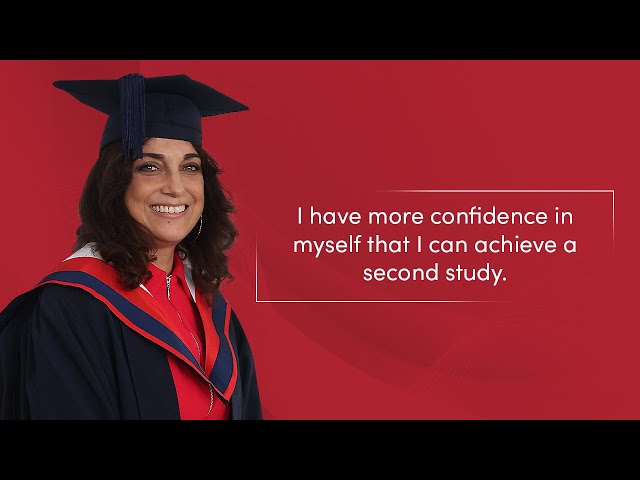
Fatma Ben Abda
Gain Self-Confidence with a Global MBA from LSBF.
Meet Fatma Ben Abda, our esteemed Global MBA graduate who shares her positive experience studying with LSBF. Fatma gained invaluable knowledge and self-confidence when she completed her MBA degree online, and learned the power of perseverance.
Request More Information
Or contact a programme advisor by calling
Student comments
Caroline Cisco
Rashme Albert
Purity Laird